
Russian and Kazakh in one question
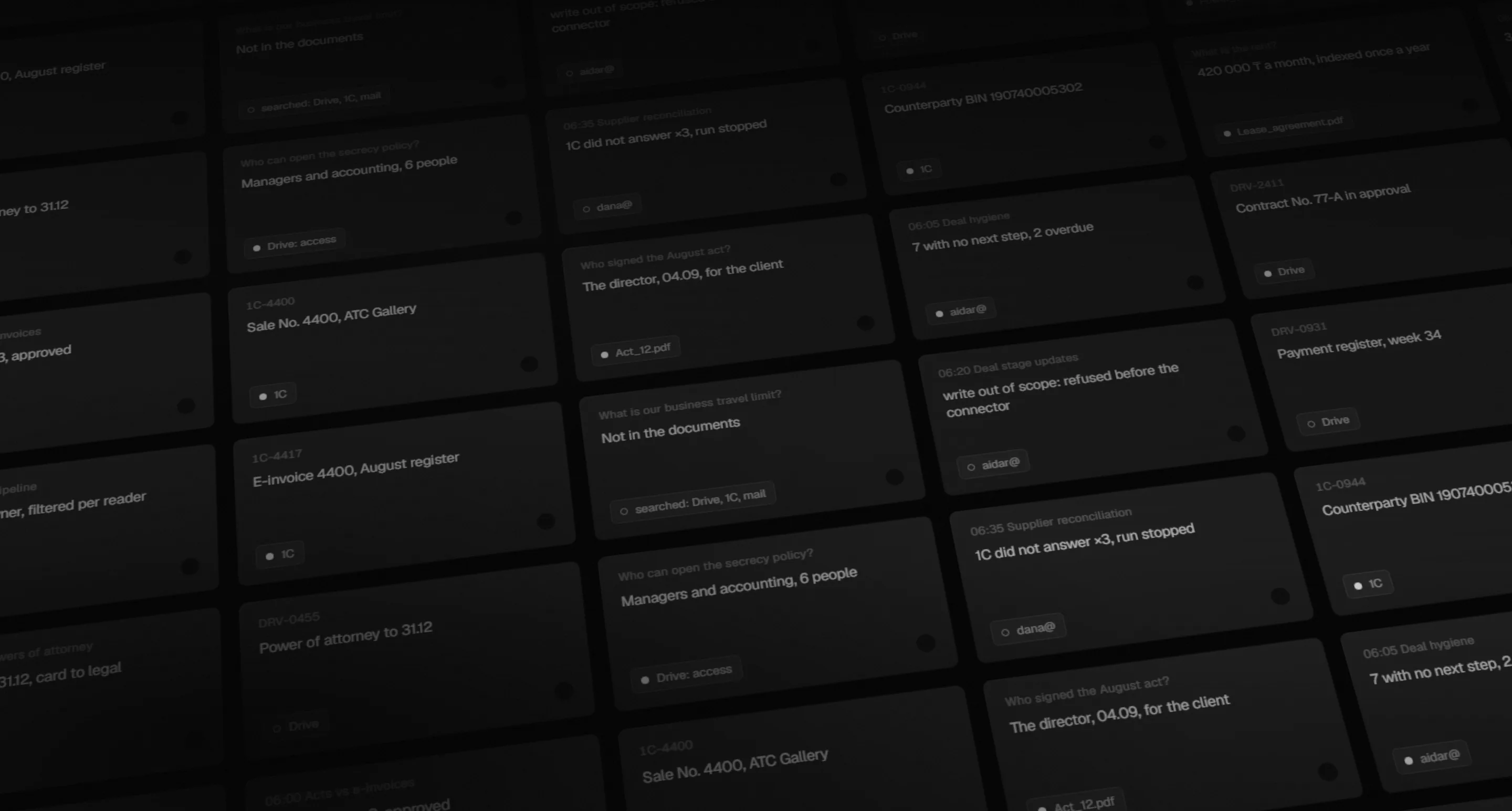
Mixed languages, one term spelled the Kazakh way and the Russian way, one counterparty named three ways in four systems. All resolve to the same records.

Products
People ask in their own words, and every line of the answer shows the document it came from.
About AssistantAssistant
The contract from Drive, the invoice from 1C, the payment from the bank, each line with its source.
Mixed languages, one term spelled the Kazakh way and the Russian way, one counterparty named three ways in four systems. All resolve to the same records.
Half a name, a rough date, a figure someone remembers. The question is matched by meaning as well as wording, so it finds the record and the two beside it.
Each agent runs one recurring task on a schedule, with its owner's rights, and writes nothing without a person.
About AgentsActs vs e-invoices
What it read, what it prepared and who approved it, beside the definition of what it may touch.
Each agent has a name a colleague would recognise, a schedule, and an owner whose identity it runs under. The log names the owner, and the failure card reaches them.
A trigger, a read scope, a write scope, an approval rule and an owner. If any of the five is missing, the agent does not exist yet.
The systems you already run, joined into one index with the permissions each of them sets.
About ContextContext
Every document arrives with its system's permissions, so the index answers each person with only what they may open.
Cursor-based sync, delta on change, and a record shape the index reads without knowing which system it came from.
Each source's sharing model is read at ingestion and becomes the check that runs on every query. We translate rules; we never assign them.
An answer or an action never reaches past what the person asking may already open.
Retrieval starts from the set the asker may read. Filtering results afterwards would already have read what it then hides.
Neither is told the other's result exists. The difference is a different retrieval, and a different count.
All three read the same index, so the next product starts from what the first one connected.
Drive and Gmail. Per-file sharing read from the source, which is what makes the permission check real.
Sales, counterparties and the product catalogue over OData, delta on DataVersion. The records this market searches by.
Deals, contacts and tasks over REST, with outbound webhooks carrying each change.
Assistant, Agents and Context run on your servers, or in a cloud region in Kazakhstan.
The same index and the same check, packaged for a datacentre you name. Nothing leaves the perimeter to be searched.
The answering model is yours to choose and yours to key. Retention is zero, training is excluded, and both are enforced at the gateway on every call.
Tell us what you run today. We will say which product fits and what it takes.