
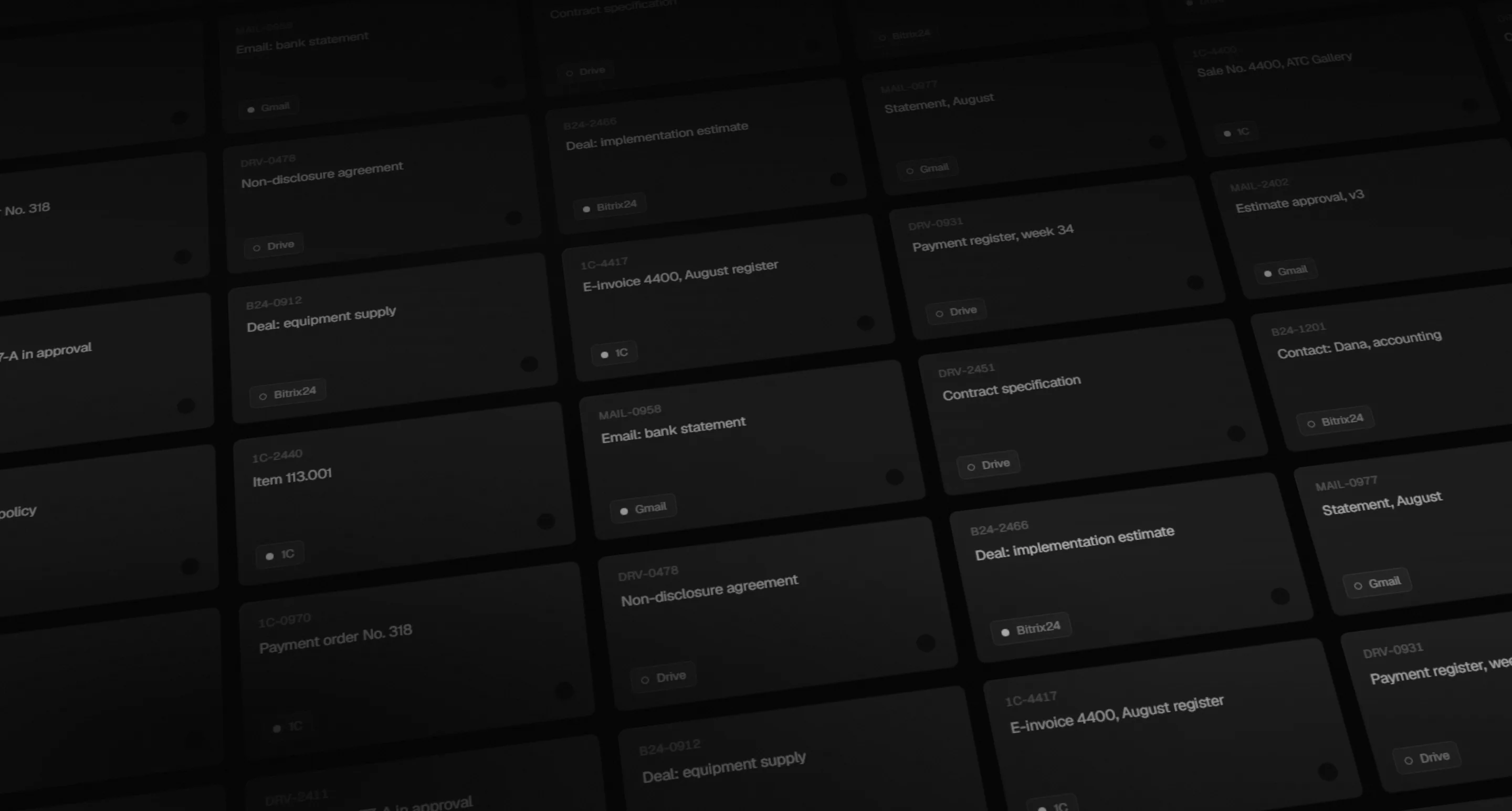
Written against one contract
Cursor-based sync, delta on change, and a record shape the index reads without knowing which system it came from.

IIIContext
1C, Drive, mail and CRM join one index, each with the permissions it already enforces. Nothing is migrated, and every result opens in its own system.
Context
Every document arrives with its system's permissions, so the index answers each person with only what they may open.
Cursor-based sync, delta on change, and a record shape the index reads without knowing which system it came from.
Each source's sharing model is read at ingestion and becomes the check that runs on every query. We translate rules; we never assign them.
BIN, IIK and contract numbers need an exact match, and search built on meaning alone misses them. Context runs both and returns one list.
A number finds its record, a phrase finds its meaning, and both come back in one list.
PDF, Word, spreadsheets and email are read in full and split into passages. A clause in the middle of a contract is as findable as its title.
Search has to understand the language before the model sees it: word forms, spelling variants, mixed sentences. Context handles both languages at every step.
Mixed Russian and Kazakh in one document, and the same counterparty spelled three ways across four systems.
People ask for what they half-remember. A loose question against a precise index finds the record and the two beside it.
On-premise, air-gapped, or a Kazakhstan datacentre. The index and the permission check run where your data has to stay.
The same index and the same check, packaged for a datacentre you name. Nothing leaves the perimeter to be searched.
The answering model is yours to choose and yours to key. Retention is zero, training is excluded, and both are enforced at the gateway on every call.
The filter runs inside the query. A document the asker cannot open never enters the candidate set, so nothing leaks through a summary, a citation or a count.
Retrieval starts from the set the asker may read. Filtering results afterwards would already have read what it then hides.
Neither is told the other's result exists. The difference is a different retrieval, and a different count.
Each system already decides who may open what, and Context applies that decision on the way out. On our own corpus: 197 of 208 files open to hello@, 51 to a client address, 0 leaks in 16 queries.
A file shared with one person is found by that person. A file shared with a link is found by everyone who holds it. Nothing is re-declared by hand.
A share revoked at the source stops here on the next sync. The check binds at query time, so yesterday's rights have nowhere to live.
One connector per source, each reading the records and the permissions that system already holds.
Drive and Gmail. Per-file sharing read from the source, which is what makes the permission check real.
Sales, counterparties and the product catalogue over OData, delta on DataVersion. The records this market searches by.
Deals, contacts and tasks over REST, with outbound webhooks carrying each change.
Every model call leaves through one gateway. It counts the tenant's spend, refuses a provider that may not see this data, and enforces zero retention in one place.
Swap the answering model without touching retrieval. A self-hosted model is a first-class choice, which an air-gapped deployment requires.
One egress point for every model call, with token and spend accounting per tenant and per agent.
A deployment in Kazakhstan constrains which provider may serve a query. The gateway refuses the rest, and no setting overrides it.
Context is delivered against a real corpus with real permissions, by the engineers who built it. Tell us what you run and where the data must stay.